The admissions process can feel bigger than it is. Many small schools delay launch because the work sits across inboxes, paper forms, spreadsheets, and even memory. However, a solid school admissions process does not require a large admissions office or months of planning. It requires a clear flow, clear ownership, and a simple system your team will actually use.
So, yes, you can launch a working school admissions process in 30 days. Here’s what you need to do: First, define the stages. Next, publish one application flow. Then assign owners, standardize follow-up, and create a clean handoff into enrollment. After that, improve what real families show you.
Can you launch a school admissions process in 30 days?
A smaller school can launch a school admissions process in 30 days, when it focuses on the core workflow first. That means one application path, one review path, one communication flow, and one enrollment handoff. In practice, most delays come from uncertainty, not complexity.
Many schools wait because they want every message, policy, and internal rule to feel perfect before anything goes live. However, that approach usually creates drift. Staff stay busy, yet the process never really starts. Families feel that hesitation quickly.
A better approach is a simple one. Build the minimum process that lets families apply, lets staff review, and lets leaders make decisions on time. Then improve the details with real feedback. This is usually faster, cleaner, and far more useful than planning in circles.
What is the school admissions process?
What is the admissions process meaning? Well, it’s quite straightforward. It is the path a school uses to move a family from first interest to confirmed enrollment. That path usually includes all of inquiry, application, document collection, review, communication, interview steps when needed, acceptance, and enrollment.
Still, many schools can confuse an application form with a full school admissions process. A form only collects information. A real process answers practical questions. Like: Who reviews each submission? What happens when records are missing? When does the family hear back? Who schedules interviews? How does an accepted student become an enrolled student without duplicate admin work? These are important questions.
And that distinction matters, because families do not judge a school only by the form. They judge it by clarity, pace, follow-through. As a result, it makes sense that the school admissions process shapes trust long before the first day of class.
Why do small schools struggle to start the private school admissions process?
Small schools usually do not struggle because admissions is conceptually difficult. They struggle because daily work is already crowded. The founder may also lead operations. The administrator may also handle billing. Teachers may also support interviews. Consequently, the admissions flow grows in fragments.
One school may have a form on its website, yet no clear status tracking after submission. Another may run warm family meetings, yet no standard follow-up. A third may rely on inbox folders and memory. That can work for a few applicants. However, it usually fails once interest starts to grow.
This is where the need to start the private school admissions process becomes urgent. If one person holds the whole process in their head, the school has a bottleneck. If no one owns the next step, the school has a leak. And if families do not know what happens next, the school has friction. Did you know that those three issues slow conversion more than most schools realize?
Why is it better to launch the admissions process before it feels perfect?
Because a live process teaches faster than a theoretical one. Once real families begin moving through your school admissions process, weak points become obvious. Instructions may need to be shorter, and missing records may need a better reminder flow. Even interview timing may need a clearer owner. Those are useful problems, because they come from reality.
By contrast, waiting for every detail to feel complete usually hides the real issues. Teams debate wording instead of testing flow. They build exceptions before they even prove the core path works. Meanwhile, families wait. Do you see the issue here?
But, there’s also a practical benefit. A live process creates internal discipline. Staff stop treating admissions as background work that happens when time appears. Instead, the school begins treating admissions as a defined function with visible movement and real deadlines. Now we’re getting somewhere. But what are the requirements?
What is the minimum system you need to launch admissions in 30 days?
You do not need a large stack of tools. You need one path families can follow and one place staff can manage it. At minimum, a workable school admissions process needs an online application, a way to collect required records, status tracking, a review step, a repeatable interview flow if your school uses one, and a clean handoff into enrollment.
That is the operating core. After that, you can improve automation, reporting, and message detail as you need it. First, get the basic flow working. Then remove friction one step at a time.
This is where school application management services become relevant. A good system reduces manual follow-up, centralizes progress, and gives a lean team a clearer way to work. If your team is comparing options, it helps to review what an admission management system is and what a strong admission management feature set should cover.
What should be ready before you start the private school admissions process?
Well, before you start the private school admissions process, you need a few decisions made in plain language. Define the stages. Decide what information you truly need upfront. Set response expectations. Clarify whether interviews are required. And then, assign ownership for each step.
You also need communication basics. Families should know what happens after they apply, how long a reply usually takes, and what additional records may be required. Even a short confirmation message can reduce anxiety and improve trust.
Equally important, do not overload the first form. Many schools ask for too much, because they fear missing something. As a result, completion rates drop and back-and-forth rises. Ask for what you need to move an applicant forward. Gather the rest later.
Who should own each step of the school admissions process?
Ownership is where a school admissions process either becomes real or stays informal. In a lean school, one person may own several steps, and that is fine. What matters is that every step has a name next to it.
A clear ownership model helps because it prevents silent delays. One person should own the first response. One person should own application completeness. Another person should have their own interview coordination. And another should own the communication for the final decision. If teachers help with evaluation, they should know what they are judging and when feedback is due.
Without that clarity, the team stays reactive. With it, the process starts to feel calm. That calm matters, because calm is what families experience as professionalism.
Now, how about we look at the whole process, week by week?
What can you set up in Week 1 of a 30 day school admissions process?
Week 1 is for structure. Define the stages of the school admissions process first. Then build the form, decide what records are required, and set response timing. In other words, Week 1 creates the frame that all later actions depend on.
The checklist preview below gives you a practical way to organize that first month. It is intentionally simple, because schools need a plan they can run, share, and repeat; especially when starting out.
| Week | Core goal | Key actions |
| Week 1 | Build the structure | Define stages, publish the application form, set first-response timing |
| Week 2 | Organize the flow | Centralize submissions, collect records, assign ownership |
| Week 3 | Move applicants forward | Review files, run interviews, update statuses, communicate decisions |
| Week 4 | Finalize and launch | Test the family journey, confirm handoff to enrollment, prepare reuse |
Once that structure is in place, the team can stop improvising every step. That shift is powerful. It replaces scattered effort with visible progress, which is exactly what a smaller-sized admissions team needs.
What should happen in Week 2 to make applications manageable?
Well, week 2 is where the school admissions process becomes manageable instead of reactive. Applications should flow into one view. Staff should be able to see what is new, what is incomplete, and what is ready for review. As a result, the team spends less time searching and more time moving applications forward.
This is also the moment to standardize internal notes and missing-document follow-up. If one school leader tracks everything in email, while another keeps notes offline, confusion returns quickly. Therefore, Week 2 should reduce tool switching and remove guesswork.
If your team wants to see how other schools simplify this stage, review how to streamline the school admissions process without drowning in paperwork. It is a useful companion piece when you’re deciding what to simplify first.
How should schools handle the private school admissions interview?
A private school admissions interview should create clarity, not stress. Schools often make interviews too loose or too formal. If the conversation is unstructured, decisions become inconsistent. And if the tone feels intimidating, families leave with more doubt than confidence.
A better approach is focused and calm. Decide what the interview is for. Are you assessing family alignment, student readiness, support needs, or just school fit? Once that purpose is clear, the conversation becomes easier for everyone involved.
Consistency matters here too. Families should know who they’re meeting, how long the meeting will take, and what happens afterward. Staff should know what to record and when to reply. Consequently, the interview becomes part of the process, not a detached event.
How do you make the admissions process easier for families?
Families do not need a complicated process. They need a clear one. If the path feels long, vague, or slow, even interested families can lose confidence. However, when the school admissions process feels organized, families are more likely to complete it. See the difference?
So, make instructions obvious. Say what must be submitted, when a reply will come, and whether a private school admissions interview is required. Avoid forcing parents to email for basic procedural answers. Each preventable question adds friction and delay.
Family experience also affects conversion. Parents are judging how the school communicates long before they experience the classroom. Because of that, a smoother admissions path supports both trust and enrollment results.
Alright. So, you’ve now gone live. What’s next?
What should happen in Week 3 after forms and interviews are live?
Week 3 is the movement stage of the school admissions process. At this point, every applicant should sit in a visible status, and every status should imply a next action. Some files are ready for review. Some need records. Then again, some need interview feedback. And some need a decision.
Momentum matters most here. If completed files sit too long, families begin to doubt the school’s readiness. By comparison, timely status changes and timely replies make the process feel respectful and credible.
Keep the rhythm simple. Review new submissions, close missing items, complete interviews, and move qualified applicants forward. Week 3 should speed decisions, not create new steps.
What should schools finalize in Week 4 before opening admissions fully?
Week 4 is for pressure testing. Now, don’t skip this. You’ll see why later. Walk the entire school admissions process as if you were a parent. Is the form clear? Does the confirmation message explain the next steps? Can staff see status quickly? Is the handoff into enrollment obvious?
This is also the right time to finalize decision templates and accepted-family instructions. Families should know exactly what to do after a “yes”. Staff should know exactly what to do after a family commits.
Just as important, think ahead. A strong process should be reusable. If stages, messages, and workflows can carry into the next cycle, the school gets faster each term instead of starting from zero again.
What are the most common mistakes schools make when they start the school admissions process?
Well, the first mistake is asking for too much, too early. The second is usually vague ownership. The third is probably unstructured interviews. Each one slows the school admissions process and creates more admin work than it saves.
Another common mistake is disconnected tooling. One spreadsheet for inquiries, one inbox for forms, one calendar for interviews, and one separate system for enrollment may feel manageable at first. However, every handoff increases friction.
The last mistake is cultural. Some schools treat admissions like paperwork, instead of a guided family experience. That mindset lowers responsiveness and lowers conversion, too. Admissions is operations, communication and trust, all working together.
What features matter most in school application management services?
In our experience, the best school application management services are not the ones with the longest feature list. They’re the ones that make the process easier to run. That usually means customizable forms, status tracking, record handling, communication support, interview visibility and, also, a clean transition into enrollment.
Ease of setup matters just as much. A founder or administrator should not need a lot of technical know-how to launch the essentials. The system should feel clear from the start and reduce admin work immediately. If your team is also comparing broader tools, it helps to review K-12 student information systems and the buying criteria in the ultimate guide to choosing a school management system.
What does a well run school admissions process look like in practice?
It looks calm. That may sound understated, yet calm is a real operational advantage. Families know what to do. Staff know what is next. And leaders can see where every applicant stands, without digging through email threads. That’s already becoming a time-saver.
Now, before the process is organized, admissions feels reactive. Someone remembers to follow up. Someone else notices an interview never got scheduled. A missing record sits in an inbox, somewhere. That’s how decisions slip. Everyone stays busy, but the school still feels behind. Maybe you, yourself, can relate to that, a little bit.
After the flow is defined, the school works differently. The form captures the right details. Statuses show progress clearly and interviews happen with purpose. Decisions go out on time and enrollment begins without duplicate entries. That’s not just a better workflow. It’s a stronger first impression of the school.
Now:
How can DreamClass help schools launch admissions in 30 days?
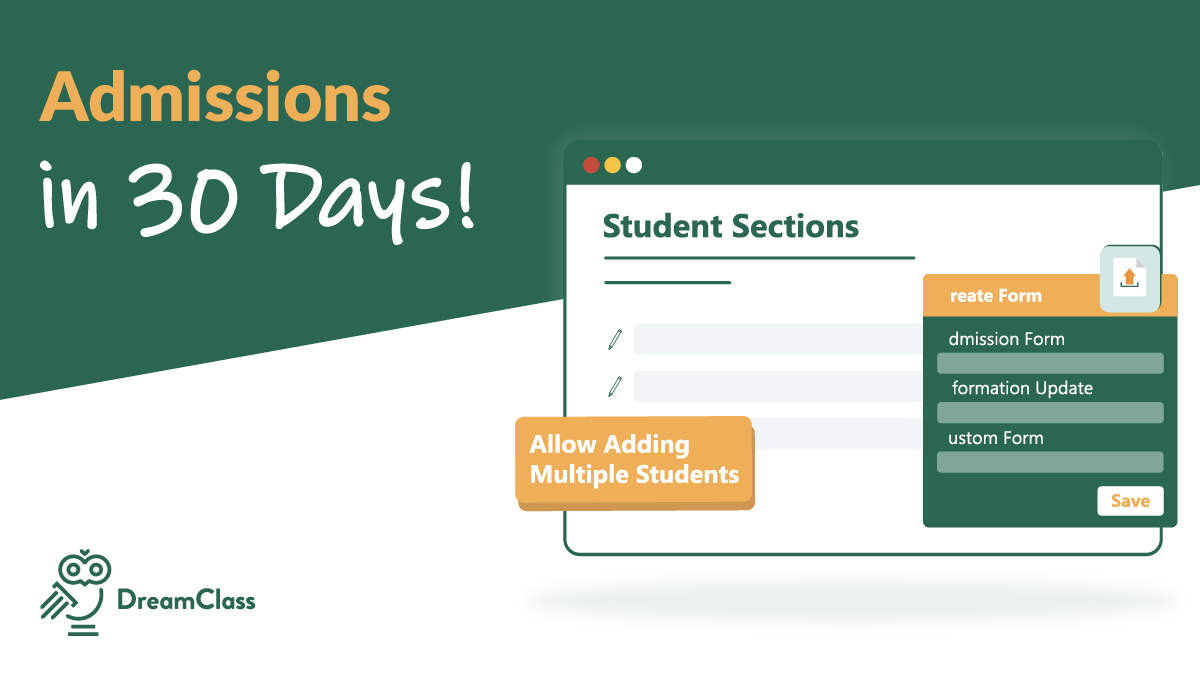
DreamClass supports the parts of the school admissions process that usually break first. Schools can create admission forms, collect applicant information, track progress, review submissions, and move accepted applicants into enrollment, without relying on scattered tools.
That matters for school teams. Instead of piecing together forms, inboxes and spreadsheets, the school gets one place to manage progress. Families get a clearer path. Administrators get better visibility. And founders get fewer moving parts to chase. Teams that want a broader view can explore DreamClass for K-12 schools and the platform’s student management capabilities, alongside admissions.
Want a faster way to launch admissions?
If your school is still managing admissions through scattered forms, inboxes, and memory, now is the time to simplify it. Download the 30-Day School Admissions Launch Checklist, assign owners, and build a school admissions process your team can launch, manage, and trust.
or scan the QR code below:


Related Reads
- What Is an Admission Management System?
- Admission Management
- How to Streamline the School Admissions Process Without Drowning in Paperwork
- K-12 Student Information Systems: The Complete Guide for School Administrators
- The Ultimate Guide to Choosing a School Management System
- DreamClass for K-12 Schools
- Customer Reviews
- Customer Stories
FAQ
Frequently Asked Questions
What is the difference between admissions and enrollment?
Admissions is the evaluation and decision path. Enrollment begins after acceptance, when the student is officially placed into the school.
How long does it take to launch a school admissions process?
A simple school admissions process can be launched in 30 days when the school focuses on core workflow, clear ownership and manageable tools.
Do all schools need a private school admissions interview?
No. Some schools use a private school admissions interview for fit and readiness, while others rely more on applications, family meetings and supporting records.
Can a smaller team manage the admissions process well?
Yes. School teams manage admissions well when each step has an owner and the work is tracked in one place.
What are school application management services?
They are tools or platforms that help schools collect applications, track status, manage communication, and move accepted applicants into enrollment with less manual work.