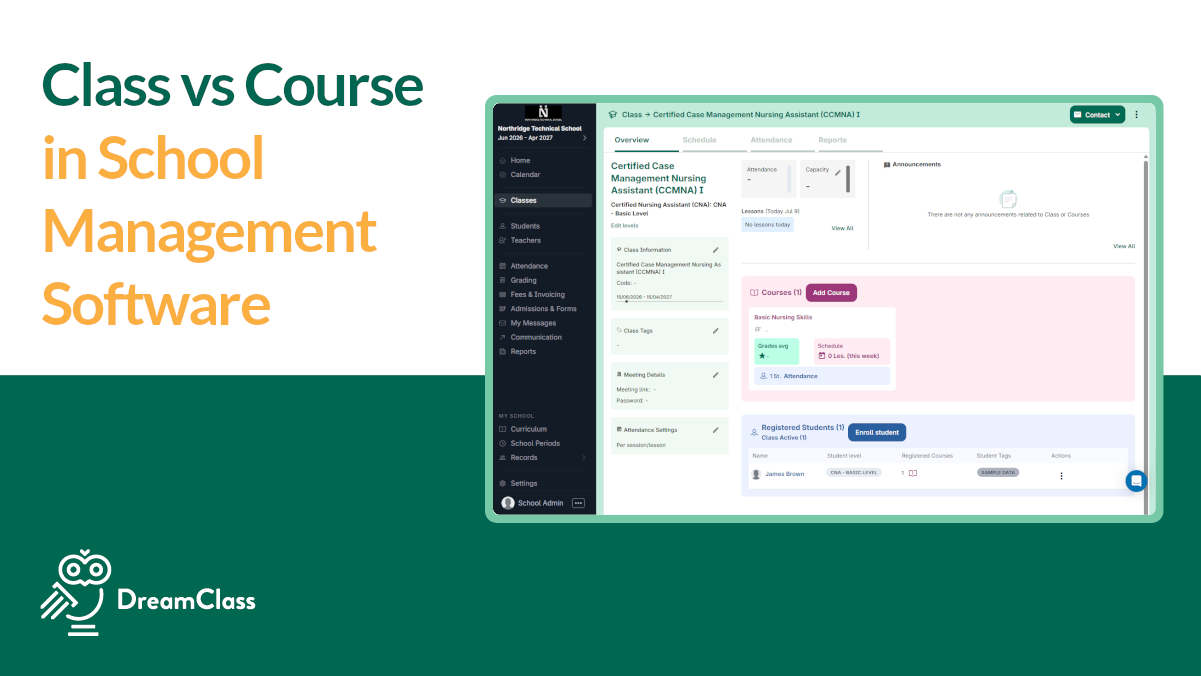
The best school management software for private schools brings attendance, grading, enrollment, billing, and parent communication into one affordable, easy-to-use platform, instead of, say, five disconnected tools and a stack of spreadsheets.
So, if you’re searching for the best school management software for private schools, you’re probably juggling five different tools right now. Attendance lives in one spreadsheet. Tuition tracking lives in another. Parent emails go out one family at a time, and report cards get built by hand every term. None of that is sustainable. Not once your school grows past a handful of classrooms, and most administrators reach a breaking point. And, mind you, that happens long before anyone tells them there’s a better way.
Let’s walk through what really separates a strong platform from a mediocre one, what real private school admins and founders say about the tools they’ve used, and how to make a confident choice without wasting weeks on solutions that go nowhere.
What Makes the Best School Management Software for Private Schools?
Not every private school management software is built for private schools. Plenty of platforms are built first for large public districts, then repackaged for smaller institutions with half the features stripped out and none of the pricing adjusted to match. That mismatch shows up fast, through clunky setup, support tickets that sit for days and, maybe even a system that assumes you have an IT department when you don’t.
The best options share a few traits. They:
- handle attendance, grading, enrollment, communication, and billing in one place, so you’re not stitching together separate sets of information.
- are simple enough for a small team, or even a solo founder, to run without a training manual.
- scale with you, so a system that works for 60 students still works when you hit 300.
A student information system typically focuses on academic records. And then, a full school management system also covers enrollment, billing, scheduling, and communication in the same platform.
Core Features to Look for in the Best School Management Software for Private Schools
Before comparing vendors, it helps to know what you’re actually shopping for. A school management system for private schools should cover the day-to-day operations that eat the most time, not just the flashy extras that look good in a sales demo. They might even do better without those extras. So, the most time-consuming daily operations may call for:
- Attendance and grading tools. You need a fast way to mark who showed up and record what’s turned in, without switching screens.
- Parent and family communication. One message to every family beats three separate emails sent from three different accounts.
- Enrollment and online registration. Families should be able to sign up and submit documents online rather than mailing in paper packets.
- Tuition and billing tracking. You need to know who’s paid, who hasn’t, and when the next invoice is due, at a glance.
- Compliance and record keeping. Whatever your State requires on file, it should be easy to pull and print when you need it.
Each of these solves a specific daily headache. And, together, they cut out most of the manual work that eats into your week. A platform that covers all five without extra add-ons or plug-ins is doing its job. That means your team logs into one place instead of struggling with several logins before the day even starts.
Attendance and Grading Tools
Marking attendance and entering grades should take minutes, not a full class period. Look for a system where teachers can log all of that from the same dashboard. That way, nothing gets lost between a paper sign-in sheet and a separate gradebook app. Eventually, a teacher taking attendance for a class of 25 should be able to mark the whole roster in under a minute. Then, move straight into recording assignment scores, without opening a second tool. Weighted grading, custom grading scales, and automatic report card generation are important here, too. Manually calculating term averages is one of the biggest time drains for small private school staff. When attendance and grading share one dashboard, absence patterns and academic performance are easier to spot side by side. And that helps administrators step in before a struggling student falls further behind.
Parent and Family Communication
Parents want to check in on their kid’s progress without calling the front office. A built-in parent portal gives families a simple login to see grades, attendance and announcements. This cuts down on repetitive phone calls and email threads. Instead of typing the same update into three separate emails, an administrator can send one announcement that reaches every family attached to a class or grade level at once. Automated alerts for missed assignments, upcoming payments, or schedule changes reduce the number of “did you get my message” follow-ups that eat into office hours. For a small private school running on a lean staff, that single change, more often than not, saves several hours a week that would otherwise go to manual outreach.
Enrollment and Online Registration
Chasing down paper enrollment forms wastes hours every admissions season. Online registration forms let new families apply, upload documents, and get confirmed without a single trip to your office. A parent filling out a digital application can attach immunization records, prior transcripts, and signed agreements in the same session. That is, of course, instead of mailing a packet and waiting for someone to manually enter it into a spreadsheet. For a founder launching a new school, that self-serve process is quite needed, since there’s rarely a dedicated admissions staffer to chase down missing paperwork. Automated confirmation emails and status updates also keep families informed, without anyone having to track applications by hand.
Tuition and Billing Tracking
Every private school runs on tuition, so billing errors are expensive in more ways than one. A dedicated tuition tracker shows exactly who’s paid, who owes money, and who’s on a payment plan, all without a separate spreadsheet. Automatic invoicing and payment reminders mean families get billed on schedule. All, without an administrator manually generating each statement. And overdue balances get flagged, rather than buried in an inbox. Support for installment plans is equally important. Many private schools offer monthly or semester-based payment options, which may be quite more convenient than a single upfront tuition charge. Real-time reporting on “total collected” versus “outstanding” tuition also gives school owners a clearer picture of cash flow than a static spreadsheet ever could. Hopefully, you’re starting to see the importance of a well-scoped, unified system.
Compliance and Record Keeping
State requirements vary, but the need to produce clean, organized records doesn’t. The best systems store academic and administrative records in one searchable place, so you can print what you need the moment someone asks for it. That includes transcripts for a graduating senior applying to college, immunization records for a State audit and, definitely, attendance summaries if a family’s enrollment status is ever questioned. Being able to pull a clean, formatted record in a few clicks, instead of digging through filing cabinets or a decade of email attachments, is what separates a system built for compliance from one that only tracks data as an afterthought.
What Sets the Best School Management Software for Private Schools Apart From Generic Tools
Plenty of vendors will tell you their platform does everything. Fewer will tell you what it doesn’t do, or who it’s built for, and that honesty is worth checking for. Especially when you compare top school software that private schools have relied on for years, against something newer and potentially unproven.
A platform earns a spot on your shortlist when it’s transparent about trade-offs. If a tool doesn’t support mobile apps yet, or if invoicing runs on a fixed monthly cycle instead of custom dates, you want to know that before you sign a contract. The strongest vendors are upfront about these limits. And they (should) keep shipping improvements based on what schools actually ask for. Most platforms built for smaller to mid-size private schools will price per student or per school each month. That’s different from the flat enterprise licensing fees common with district-scale systems. Now, many systems, including DreamClass, are priced specifically for schools with a few dozen to a few hundred students. So, cost scales with your school size, not by assuming district-level enrollment.
Is DreamClass the Best School Management Software for Private Schools for Your Team?
DreamClass was built for private K-12 schools, vocational programs, and other independent education providers, like homeschool co-ops. This means the features map directly to what administrators and founders deal with daily. That includes attendance, grading, tuition tracking, parent communication, enrollment, and compliance records, all inside one login. And all that is largely based on a simple fact. Private schools make up roughly a quarter of all K-12 institutions in the United States, according to the National Center for Education Statistics. And most of them run with far smaller admin teams than public districts. This is exactly the “gap” (as in specific underserved set of needs) this kind of platform is built to close.
For a solo founder still setting up a new school, that consolidation will, oftentimes, make or break the school. In such cases, “fast, effective and efficient” does it. Rather than learning five separate tools, you can set up one system once and it handles the rest. For an established private school administrator managing a growing student body, the same system scales without forcing a painful migration later. Many of our users have spoken to that.
What Private School Administrators and Founders Are Saying
Real reviews back this up. One private school office manager described the impact directly:
Game-Changer for Private Schools
Lida is the best communicator and is always available to walk me through new processes. DreamClass has truly simplified our administrative tasks, allowing us to focus more on what matters most — our students and their spiritual growth. We highly recommend it to other small schools
Office managerPrimary secondary education
A school owner running a small independent program shared a similar experience:
Life Saver
This software streamlines all of our administrative processes and allows us to access them all in one system.
School OwnerEducation management
And a school director focused on operational efficiency put it this way:
Great school management software with responsive support
By implementing Dreamclass we have streamlined our processes at the school, reduced data entry and increased transparency of account management to reduce errors. Overall a great boost to business productivity.
DirectorPrimary secondary education
These reviews point to the same pattern: less manual work, fewer scattered tools, and more time spent on the parts of running a school that actually need a human.
How to Choose the Best School Management Software for Private Schools
By this point you’ve likely narrowed your list down to two or three real contenders, each with its own pricing page and feature list that can be hard to compare at a glance. Once you’ve narrowed your options, run each vendor through the same short checklist so you’re comparing apples to apples. Besides, relying on whichever sales rep gave the smoothest pitch won’t get you where you need to be. So, consider these:
- Does it cover attendance, grading, billing, enrollment, and communication without needing extra paid add-ons?
- Can your team set it up without hiring outside help or a dedicated IT hire?
- Does the pricing fit a school your size, not a district, say, ten times bigger?
- Is customer support responsive when something breaks mid-semester?
- Do current customers, especially other private schools, say good things in their reviews?
If a platform checks every box on that list, it’s worth a real trial run. If it only checks two or three, you should probably keep looking. The cost of switching systems again in a year is almost always higher than the cost of choosing carefully now.
Ready to Try the Best School Management Software for Private Schools?
Running a private school already takes many hours. The right software should give you some of that time back. So, whether you’re a founder building a school from the ground up or an administrator trying to bring order to five different spreadsheets, a platform like DreamClass is built to handle the daily operations, so you can focus on the students in front of you. See our pricing to find the plan that fits your school.
Related Reads
- How New Private Schools Scale From Spreadsheets to Admin-Ready School Management Systems
- What Are the Top-Rated School Management Systems for Small Private Schools?
- The Ultimate Guide to Choosing a School Management System
- What Established Private Schools Need From a School Management System
- Reducing Enrollment Friction: A Practical Guide for Private School Administrators
FAQ
Frequently Asked Questions
What’s the best school management software for private schools?
The best school management software for private schools brings attendance, grading, enrollment, billing, and parent communication into one affordable, easy-to-use platform, bringing clarity and efficiency.
How much does private school management software cost?
Most platforms built for smaller to mid-sized private schools will price per student or per school each month, avoiding flat enterprise licensing fees common with district-scale systems.
Can small private schools afford a school management system?
Many systems, including DreamClass, are priced specifically for schools with a few dozen to a few hundred students, so cost scales with your school size.
Do I need technical experience to set up school management software?
They’re simple enough for a small team, or even a solo founder, to run without a training manual.
What’s the difference between a student information system and a school management system?
A student information system typically focuses on academic records. A full school management system also covers enrollment, billing, scheduling, and communication in the same platform.