A private school SIS should cover student records, admissions management, attendance tracking, tuition billing, a parent portal, report cards, scheduling, and role-based access control. Which of those you need on day one depends on your school’s size, stage, and where your administrative time is currently going.
Most private schools shopping for a student information system aren’t starting from zero. They’re likely moving off spreadsheets, paper files, or a mix of disconnected tools that don’t talk to each other. That said, the right private school SIS doesn’t just digitize your existing workflows. It actually cuts the time those workflows actually take. According to the National Association of Independent Schools, the median NAIS member school enrolls 364 students. Meaning, most private schools run on lean administrative teams where every minute saved is a big deal, a benefit.
What Does a Private School SIS Actually Need to Do?
The core job of a private school SIS is connecting student data across every part of your operations. Enrollment feeds into academics, attendance feeds into report cards, billing ties back to the family record. When that data lives in one place, your team stops re-entering the same information across multiple tools and starts making decisions faster. You probably already know that to be true.
Now, private schools also face different operational demands than public ones. You’re managing enrollment without a district mandate, collecting tuition without a government budget, and communicating with families who expect a professional experience. Your private school management software has to support all of that. Ideally, without requiring a dedicated IT person to run it. For schools with small admin teams, the SIS is often the only system connecting every operational department. So, it needs to be reliable from day one.
What Are the Essential Features of a Private School SIS?
Not every feature a vendor lists is one you’ll actually use. However, a handful are genuinely non-negotiable for most private K-12 schools. A strong private school SIS covers all six of the following areas. Gaps in any of them will create workarounds you’ll feel across every term.
- Student records: Centralized profiles covering personal details, academic history, family relationships, and enrollment status across school periods. Re-enrollment without duplicate data entry is a baseline requirement.
- Admissions management: Online applications, status tracking from inquiry through enrollment, and automatic conversion of accepted applicants into student profiles. Manual spreadsheet exports between your admissions tool and your SIS are a sign the two systems don’t belong together.
- Attendance tracking: Attendance that connects directly to gradebooks and report cards, so absence data doesn’t need to be manually reconciled at the end of each term.
- Tuition billing: Fee assignment, installment plans, discounts, invoice generation, and online payment options. This is one of the clearest dividing lines between a public school SIS and a private school SIS.
- Parent portal: Role-based access that gives families direct visibility into grades, attendance, invoices, and report cards without routing every request through your front desk.
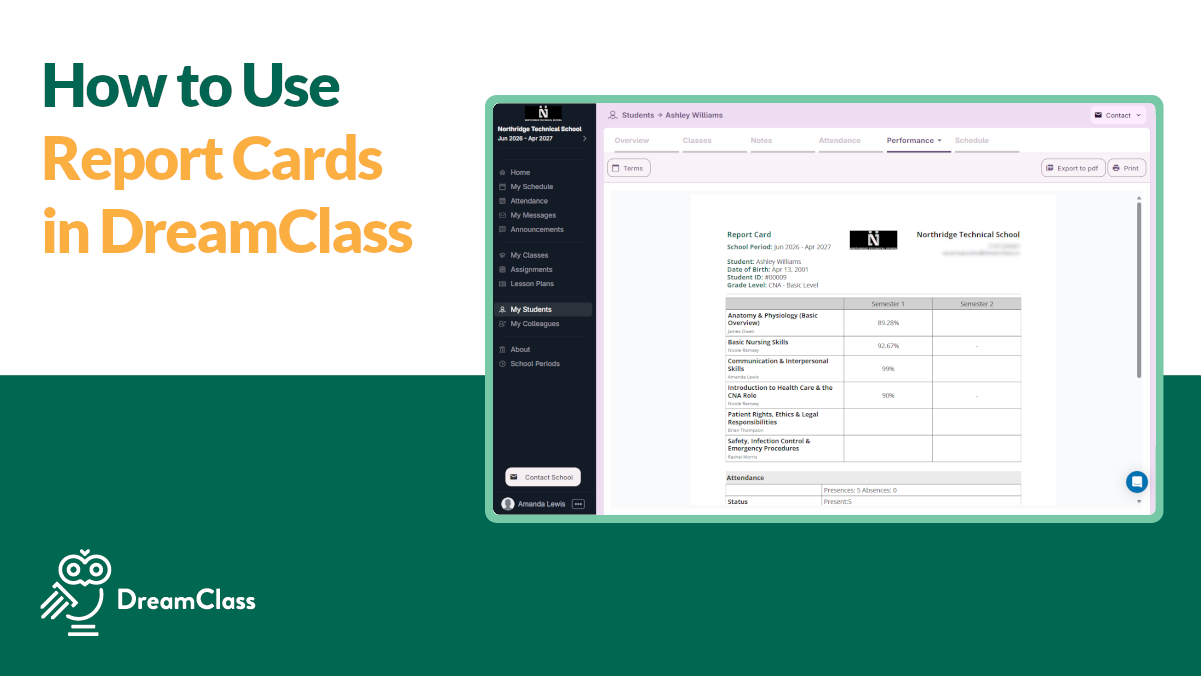
- Report cards: Auto-generated from gradebook and attendance data, with support for custom grading schemes, teacher comments and print-ready PDF exports.
SO, these six features form the functional baseline of any capable private school SIS. If a platform doesn’t cover all of them out of the box, you’ll be patching the gaps with tools that don’t connect. But that’s exactly the problem you’re trying to solve. Isn’t it? Just like Athena W.:
Seamless Transition & Support with DreamClass
Having the school calendar, student financials, attendance, assignments, SIS and applications all in one place is the greatest benefit. We had 4 different platforms prior to DreamClass and are now able to function as a school in one. This has been extremely effective and efficient.
SLS Operations DirectorEducation management
How Should a Private School SIS Handle Tuition and Billing?
Tuition billing is arguably the feature most private school administrators get wrong first. It needs to do more than log that a payment arrived. According to NAIS, the average day-school tuition at independent schools reached $32,251 in 2024-25. That means billing errors, missed installments, or slow follow-up aren’t minor inconveniences. They actually affect family relationships and your school’s cash flow directly.
A solid private school SIS handles the full billing cycle. That includes creating fee agreements, generating installment schedules, issuing invoices to multiple payers per family, and accepting online payments through methods like Stripe, Apple Pay, and Google Pay. DreamClass also includes an automation layer that lets schools set recurring billing logic once and leave it running. And what that does is it removes the need to manually trigger invoices at the start of each billing cycle.
Schools relying on manual billing processes spend more time chasing payments than they realize. When billing is part of your private school SIS, outstanding invoices are visible at a glance, and follow-up takes a single click, rather than a spreadsheet audit.
Game-Changer for Private Schools
The platform has made managing student records, attendance, and fee tracking much more efficient.
Office managerPrimary secondary education
What Features Are Unique to a Private School SIS?
Several features appear on private school SIS checklists that public school systems simply don’t need. Custom tuition fee structures and multi-payee invoices handle financial complexity that doesn’t exist in public education. Bilingual report card support covers international and dual-language programs. DreamClass, for example, includes French-language report card translations for international schools and bilingual programs. White-label domain options let established schools present the platform under their own brand, rather than a vendor subdomain, which is increasingly important as a school’s reputation grows.
Scheduling flexibility is another private-school-specific need. Class structures in private schools vary widely by program type, so your private school SIS should support both recurring and one-off class scheduling, without forcing your timetable into a rigid template. Custom admissions workflows similarly accommodate selective enrollment processes, rather than the open-access registration that public systems are built around.
Now, truth be told, these features aren’t universal requirements. But they’re worth confirming before you commit, because adding them to a platform that doesn’t support them isn’t always possible after the fact.
What Should New School Founders Look for in a Private School SIS?
If you’re launching a new school, start with the features that cut the most manual work immediately, through admissions, student records, and tuition billing. Adding scheduling and communication tools as enrollment grows is considerably easier than trying to backfill paper records after your first year.
With this in mind, DreamClass is built to support schools from their first enrollment. Trial accounts launch with sample data already loaded, so evaluation starts in a working school environment, rather than an empty dashboard. When a school is ready to go live, clearing that sample data and importing real records takes a single click. That’s a meaningful difference from platforms that require weeks of configuration before you can see how anything actually works.
Also look for end-to-end admission automation. DreamClass can handle the full sequence from submission through student creation, fee assignment, and invoice generation, without a staff member touching each record individually. For a new school with one administrator managing everything, that level of automation isn’t a nice-to-have. It’s what keeps operations running during your first enrollment cycle.
Great features, amazing support
amazing! it’s exactly what we need at an affordable price. where i run into a problem the support is personalized, fast, specific, and extremely helpful.
AdminEducation management
Where Does DreamClass Fit as a Private School SIS?
DreamClass is built for mostly mid-sized private schools, new school founders, and education programs that need one organized system without the implementation complexity of enterprise platforms. It covers every feature category described in this guide, without requiring IT staff to continuously run it. Given that the median NAIS member school enrolls 364 students, DreamClass is purpose-built for the size and budget of schools that make up most of the private K-12 market.
The table below maps common private school SIS needs directly to DreamClass capabilities. For that, only features DreamClass currently supports are included.
| Private school SIS need | DreamClass capability |
|---|---|
| Student records | Full profiles across school periods, re-enrollment without duplicate entry |
| Admissions management | Custom forms, status tracking, direct conversion to student profiles |
| Attendance tracking | Teacher-led attendance with late-arrival marking, auto-linked to report cards |
| Tuition billing | Fee assignment, installment plans, multi-payee invoices, Stripe/Apple Pay/Google Pay |
| Parent portal | Grade, attendance, invoice, and report card access; direct teacher messaging |
| Report cards | Auto-generated from gradebook data, custom grading terms, bilingual support, print-ready PDFs |
| Role-based access | Separate portals for admins, teachers, students, and guardians |
DreamClass doesn’t require a dedicated IT staff member to operate. Trial accounts launch with sample data already in place, so your evaluation starts in a working school environment on day one.
Ready to see how DreamClass handles your school’s operations?
Related Reads
If this guide raised more questions about how to set up and manage your school’s systems, these posts cover the next steps:
FAQ
Frequently Asked Questions
What is the most important feature in a private school SIS?
Student records management is the foundation. Every other function depends on accurate, centralized student profiles. Without clean records, attendance, grades, billing, and communication, all become unreliable downstream.
Do private schools need tuition billing in their SIS?
Yes. Private schools collect tuition directly from families, creating billing complexity that public schools don’t face. A private school SIS with built-in tuition billing handles fee structures, installments, multi-payee invoices, and online payments in one place.
Should a private school SIS include admissions software?
Ideally, yes. Admissions built into your SIS means accepted applicants convert directly into student profiles with no re-entry step. Standalone admissions tools will create a data gap between your enrollment process and your student records.
What is the difference between a private school SIS and a public school SIS?
Private school SIS platforms handle tuition billing, selective admissions workflows, and flexible grading schemes that public systems don’t require. Public SIS tools are built around district mandates and government reporting rather than independent billing and enrollment.
Is DreamClass a private school SIS?
Yes. DreamClass is a student information system built for private K-12 schools, new school founders, and education programs. It covers admissions, student records, attendance, grading, tuition billing, and parent communication in one platform.